

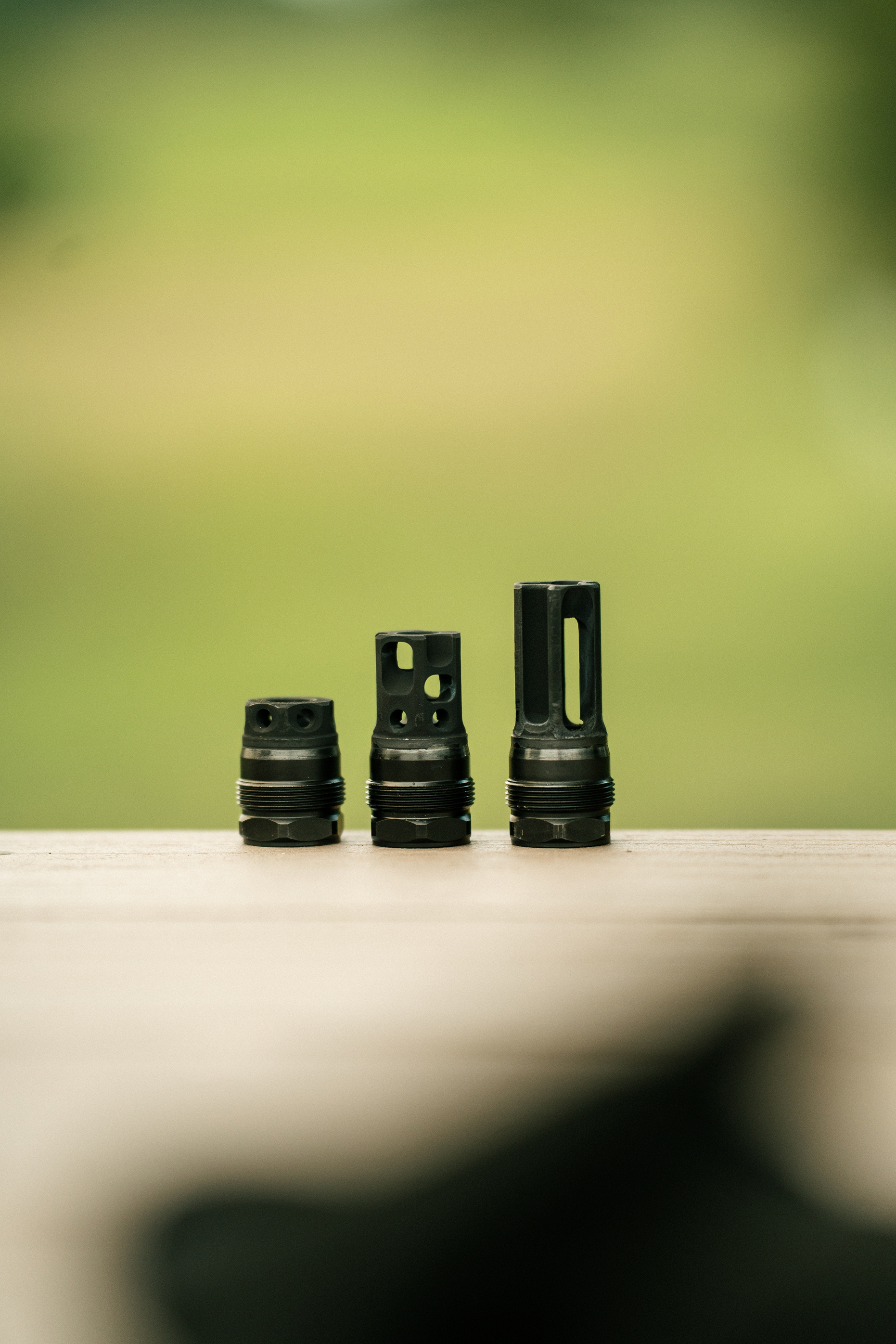
Why Your Muzzle Device Matters More Than You Think
When building a rifle, it’s easy to focus on the big-ticket components.
The rifle. The optic. The suppressor.
Those are the pieces that usually get the most attention—and for good reason. They’re major investments that can dramatically affect how a rifle performs.
But there’s another component sitting at the end of your barrel that deserves a little more consideration.
Your muzzle device.
Whether you’re running a muzzle brake, flash hider, suppressor mount, or another mounting solution, that small piece of metal can play an important role in how your rifle performs. From recoil management and rifle weight to suppressor compatibility and overall reliability, the right muzzle device is more than just an accessory.
It’s part of the system.
It All Starts With Alignment
When you’re attaching anything to the end of your barrel—especially a suppressor—precision matters.
Your muzzle device becomes the connection point between your rifle and whatever comes next. That means proper threads, concentricity, machining tolerances, and overall fit all play an important role.
A quality muzzle device should be designed and manufactured to provide a precise, consistent interface with your rifle.
This isn’t the place to cut corners.
Your barrel, muzzle device, mounting system, and suppressor all work together. If you’re investing in a quality rifle and suppressor, it makes sense to give the components connecting them the same level of consideration.
Weight Matters More Than the Number on the Spec Sheet
A few ounces may not seem important when you’re looking at a muzzle device by itself.
But rifles aren’t carried one component at a time.
Add together your optic, rings, bipod, suppressor, ammunition, sling, and everything else attached to the rifle, and those ounces start adding up quickly.
This is especially important for hunters building lightweight rifles.
The goal isn’t always to choose the absolute lightest component available. It’s about finding the right balance between weight, durability, performance, and the intended use of the rifle.
A rifle that spends its life shooting from a bench may benefit from a completely different muzzle device than one being carried through the mountains for days at a time.
The right choice depends on what you’re asking the rifle to do.
Recoil Management Doesn’t End With the Rifle
One of the most obvious jobs of a muzzle brake is managing recoil.
By redirecting expanding gases, a properly designed brake can help reduce felt recoil and muzzle movement. Depending on the cartridge and rifle configuration, that can make it easier to stay on target and recover more quickly after the shot.
For some shooters, recoil reduction may be the primary concern.
For others, it may be secondary to weight, suppressor compatibility, or flash suppression.
That’s why there isn’t one “best” muzzle device for every rifle.
A lightweight hunting rifle chambered in a hard-hitting cartridge has different needs than a competition rifle or a general-purpose range gun. Understanding how and where you’ll use the rifle is an important part of choosing the right setup.
Suppressor Compatibility Should Be Part of the Plan
If you plan to run a suppressor, your muzzle device shouldn’t be an afterthought.
The mounting system you choose can affect everything from how the suppressor attaches to the rifle to how easily you can move it between different firearms.
Compatibility matters.
Thread pitch matters.
Caliber matters.
And the specific mounting system matters.
Before purchasing a muzzle device, it’s important to understand exactly what it was designed to work with. Choosing components as part of a complete system can help eliminate unnecessary complications when it’s time to put everything together.
Think beyond the individual product.
Think about the entire rifle.
A good setup starts with understanding how each component works with the next.
What Happens When the Suppressor Comes Off?
A muzzle device still has a job to do when your suppressor isn’t attached.
Depending on its design, it may help manage recoil, reduce muzzle rise, minimize visible flash, or simply provide the mounting interface you need when the suppressor goes back on.
That versatility can be important for shooters who don’t run their suppressor 100% of the time.
Maybe your suppressor is being used on another rifle.
Maybe you’re heading to the range and don’t need it.
Maybe you’re changing your setup for a specific hunt or application.
Whatever the reason, it’s worth considering how your rifle will perform both suppressed and unsuppressed.
Quality Machining Matters
A muzzle device might be a relatively small component, but it has an important job.
It needs to interface correctly with the barrel. In some setups, it needs to provide a secure and repeatable mounting surface for a suppressor. And it needs to withstand the extreme heat, pressure, and abuse generated at the muzzle.
That’s why material selection, machining quality, thread fit, and design all matter.
The best muzzle device for your rifle isn’t necessarily the biggest, lightest, or most aggressive-looking option.
It’s the one designed to do the job you’re asking it to do—and to do it consistently.
Build the System, Not Just the Rifle
It’s easy to look at a muzzle device as one more item on a parts list.
But when you take a step back, it’s clear that it connects to nearly every aspect of your rifle’s performance.
It can affect:
- Suppressor mounting and compatibility
- Overall rifle weight and balance
- Felt recoil and muzzle movement
- Flash and muzzle signature
- The way your rifle performs suppressed and unsuppressed
- The reliability of the entire system
The details matter.
When you’re building a rifle you plan to carry into the field, shoot at distance, or rely on when the opportunity finally presents itself, every component should have a purpose.
Your muzzle device is no exception.
Your suppressor may get most of the attention. But the component connecting it to your rifle deserves a closer look.
Explore LPM’s lineup of muzzle devices and find the right foundation for your next rifle build.


Leave a Reply